Labeling Instagram Ads in 2026
When, how and why it’s getting serious
No payment received? Can still be advertising. No contract signed? Now mandatory. Had no idea? Ignorance is no defense.
If you’re active as a creator in Germany, this directly affects you. The legal situation around disclosure requirements has tightened noticeably in 2026, not because of a new law, but because of how existing laws are now being applied more consistently. The old rule of thumb “no fee, no problem” no longer applies. It never really did. It’s just that now it’s explicitly rejected in court.
The alarming part: According to a European Commission study, around 80% of all influencers label commercial content incorrectly or not at all. Most not by design, but because they don’t know where the line is. This article shows you exactly where that line lies.
The OLG Karlsruhe ruling of 03.03.2026 – What has changed?
To understand what has changed, a concrete case helps and it’s exactly the kind of situation that could happen to you.
An automotive influencer with around one million followers is invited by several car manufacturers to press events. She receives vehicles from Audi, BMW, and Volvo free of charge. Travel, hotel, meals everything covered. She then posts professional reels about the vehicles. Authentic, personal, without any advertising disclosure.
No contract signed.
No obligation to post.
No fee.
The Higher Regional Court of Karlsruhe still found against her. Cease and desist. The posts should have been labeled as advertising.
Why?
The three core points of the ruling
1. It’s not the payment that decides, it’s the expectation. Companies don’t invite influencers because they’re nice people. They invite them because they want reach. This economic expectation that you’ll post about their product turns an invitation into a material benefit. Whether it’s stated anywhere or not.
2. There is no de minimis threshold. No amount is too small to count as consideration. A lunch, an overnight stay, a test vehicle for two days, all of it counts. The Federal Court of Justice clarified this in 2022; the OLG Karlsruhe confirmed it in 2026.
3. Your followers are not the only benchmark. Instagram also serves your content to people who have never followed you and don’t know your commercial background. Advertising must be immediately recognizable to these people too, before they start watching, not at the end of the video.
The question is no longer whether, but when. When does the disclosure requirement apply? In which situations are you affected? And where is the line between a harmless post and one that costs you a legal warning?
When do I have to label Instagram Ads? The 6 trigger situations
The disclosure requirement doesn’t only apply to classic paid deals. It applies in every situation where a commercial background exists and that’s in more cases than most people think.
1. Paid Collaboration: The clearest case and still the most common mistake. If you receive a fee for a post, you disclose. Always. No exceptions. Regardless of whether the contract is called a “Content Creator Agreement” or a “Collaboration Request,” whether it’s a one-time or ongoing partnership. Paid means advertising. Legal basis: § 6 DDG, § 5a UWG.
2. Free Product: You receive a packag skincare, clothing, tech, snacks. No contract, no agreement about a post. You post anyway because you like it. The disclosure requirement still applies. The mere provision of a product constitutes a material benefit. Receipt is what counts, not the intent behind it.
3. Press Trip or Event Invitation: Flight, hotel, catering all covered. No briefing, no contract, no explicit request to post. You post because it was a great experience. The disclosure requirement still applies. The invitation alone is enough, because it was extended with the expectation that you’d report on it.
4. Discount Codes, Affiliate Links, and Commissions: You have your own code that gives your followers a discount and you earn a commission. Every post, every story, every reel promoting that code or link is advertising. No grey area, no wiggle room.
5. Your Own Brand or Product: You have your own label, merch shop, or service. When you post about it, you must label it. The commercial self-interest is obvious, and courts have affirmed disclosure obligations in this context too.
6. Self-Purchased Product with Excessive Promotional Character: You bought a product yourself, no contact with the brand whatsoever. Generally not a problem but if your post comes across as excessively promotional (almost professionally staged, only positive statements, direct shop link, no personal context), it can still trigger a disclosure obligation.
How must advertising be correctly labeled on Instagram?
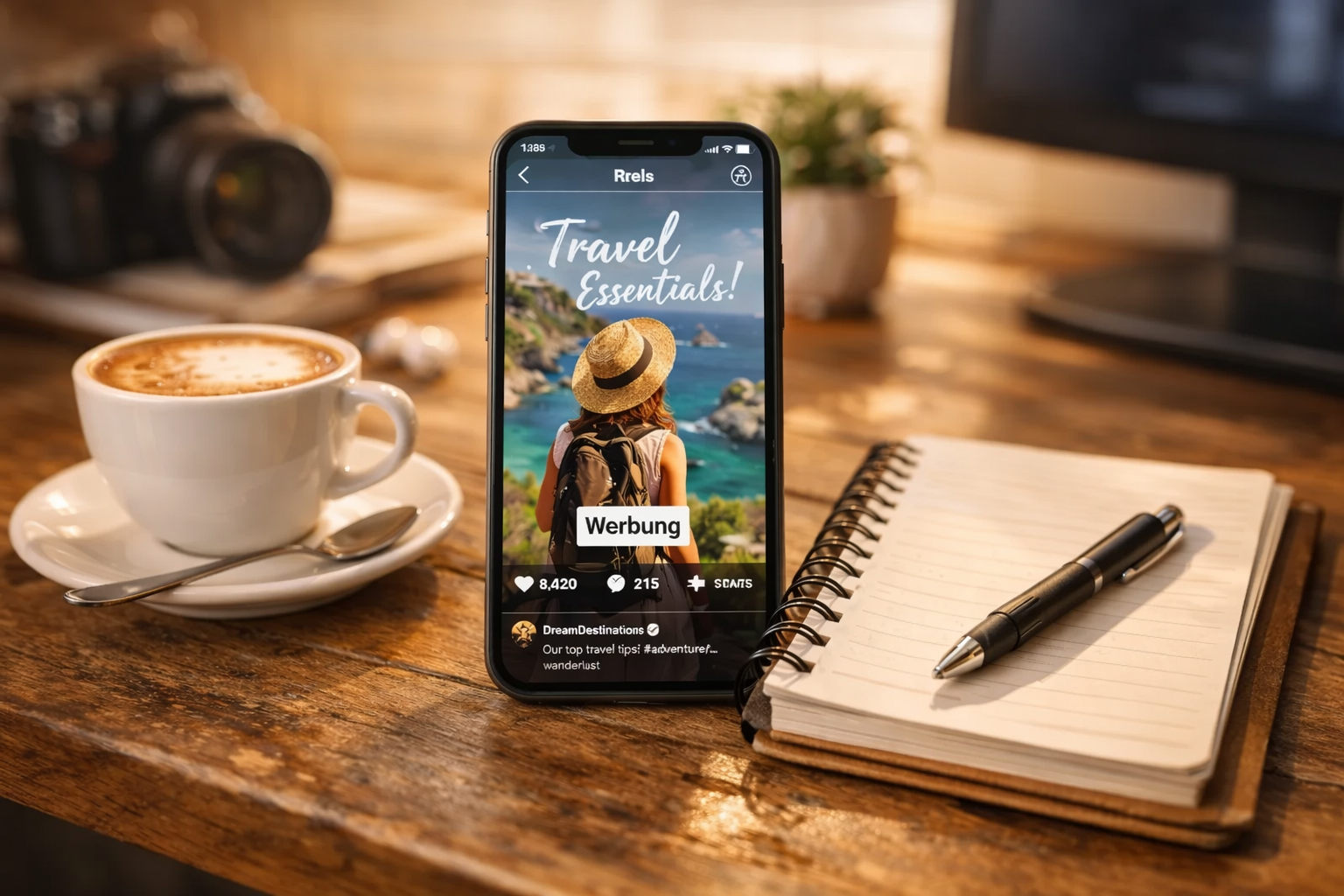
The rule is simple. The commercial nature must be recognizable at first glance. Before the user starts reading. Before they start watching.
Feed post: The disclosure goes at the very top, before the first word of your text. Not at the end of the caption, not after three lines of “read more.” Right at the top.
Reels: The notice must appear at the start of the reel, before the product is shown, before the actual content begins. A caption appearing after the product is already on screen is not sufficient. And a notice visible for only ten seconds is also not enough.
Stories: Every individual story with an advertising connection must be labeled. A note on the first story doesn’t cover all subsequent ones. Five stories about a product means five disclosures.
Accepted terms:
- Advertisement → always the safest choice
- Ad → also accepted
- brand name → via the Branded Content Tool
- brand name → for clearly defined collaborations
Not sufficient:
- “#ad” or “#sponsored” → not recognized in the German-speaking context
- Hashtags hidden among other hashtags
- Label only in the caption, not in the reel itself
- Label only at the end of the video
- On-screen display for less than ten seconds
The rule of thumb: Imagine someone sees your post for the very first time, doesn’t know you, isn’t following you, has no context. Would that person immediately recognize it as advertising? If the answer is no or even maybe, label it differently.
What counts as a material benefit and where is the line?
Everything with economic value that is connected to a post counts as material consideration. No exceptions, no minimum amount. A lunch. A T-shirt. An overnight stay. Yes, really there is minimum value below which this rule doesn’t apply.
What specifically falls under this:
- Direct payment or fee
- Free product to keep
- Press trip (flight, hotel, transfers, meals)
- Event invitation with costs covered
- Discount code for personal use
- Affiliate commission (regardless of amount)
- Upgrade, VIP access, or exclusive experiences
The only real grey area: Free product testing with a return obligation. The legal situation here hasn’t been definitively resolved. But while you’re using the product, you have a temporary economic advantage and anyone posting about it during that time should disclose.
The question to ask before every collaboration: Would I have otherwise paid for what I received? If yes, disclose to be safe.
Special case: Self-purchased products & excessive promotional character
You bought a product yourself. No brand reached out. No package, no email, no deal. You post because you genuinely like it. No problem, right?
Generally, no. But the Federal Court of Justice has drawn a line that many creators are unaware of: even without any consideration, a post can be subject to disclosure requirements if it no longer feels like a personal recommendation but looks like an ad. This is called “werblicher Überschuss” (excessive promotional character).
How to spot it in your own content:
- Do you show only positive aspects, with no critical comment?
- Is the post professionally staged, perfect lighting, perfect cuts, almost like a commercial?
- Do you link directly to the brand’s shop or product page?
- Is there no personal context, why you use the product, how you came across it?
- Would an outside viewer take this post for paid advertising?
If you answer yes to two or more of these questions → disclose.
The simplest protective strategy: Show yourself. Show your real opinion. Show what you don’t find perfect about a product too. This protects you legally and makes your content more credible and credibility is what your community expects from you.
Does the disclosure requirement apply to private people?
Short answer: No. If you use social media purely privately, you’re not affected. Recommending a restaurant, showing a product you bought yourself, documenting your everyday life none of that is commercial content, regardless of whether your profile is public or private.
But the transition from private to commercial account often happens gradually and faster than most people think. These signals turn a private profile into a commercial channel:
- You have an Instagram business profile
- You engage in collaborations
- You regularly promote products or services
- You use affiliate links or discount codes
- You’re actively building your follower base with the goal of monetizing your reach
If one or more of these apply to you, you can no longer rely on the private individual exception. Not even with three thousand followers. Not even if you still consider yourself a “small account.”
The disclosure requirement has no minimum follower count. It has only one benchmark: the commercial background.
What to check before every post
Step 1: Did I receive anything? A product, an invitation, a trip, a discount code, a commission. If yes → disclose. No ifs or buts.
Step 2: I received nothing but how does the post look? View your content through a stranger’s eyes. Professionally staged, entirely positive, direct shop link, no personal context? If someone who doesn’t know you would take it for paid advertising, it legally is. Disclose anyway.
Step 3: Is the notice in the right place? Not at the end. Not hidden. Not after three lines of caption. Right at the top, before the content begins. At the start of reels. On every individual story with an advertising connection.
Step 4: Is the term clear and in English? No “#ad,” no “#sponsored,” no English terms they don’t protect you in the German-speaking context.
Step 5: Have I documented the collaboration? This is the step most people skip and the one that decides everything in a dispute. Record what you received. Or what you didn’t receive. A screenshot, a quick note, an email. The burden of proof lies with you. Whoever documents nothing has nothing to show in an emergency.
When in doubt: always disclose. An unnecessary disclosure costs you nothing. A missing one can mean a legal warning, a cease-and-desist ruling in the OLG Karlsruhe case alone, €374.50 in legal warning costs and in the worst case, the trust of your community. That’s the damage that’s hardest to repair.
Conclusion: The rules have changed and those who don’t know them lose
The disclosure requirement is not a bureaucratic detail invented by lawyers to make creators’ lives difficult. It’s the response to an industry that has grown large enough to be taken seriously. Billions of euros flow into influencer marketing every year and where big money flows, the courts are watching, more consistently than ever before.
What you should do now:
- Review your existing posts. Are there older posts still online that weren’t labeled when they should have been? They can still be subject to legal warnings. Better to fix them now than explain them later.
- Make disclosure a routine. Not an afterthought, but a fixed part of your process before you post, not after.
- Document every collaboration. No matter how small, no matter how informal.
- Talk to your agency or management. If you work professionally, it’s their job to inform you and set clear guidelines in every briefing.
And one more thing that’s often forgotten: disclosure doesn’t harm your content. It makes it more credible. Your community knows you do collaborations, that’s no secret and no flaw. What they expect is honesty. Those who handle it openly build trust. Those who hide it risk losing exactly what they’ve worked years to build.
The legal situation in 2026 is clear. Your community’s expectations are too. Both point in the same direction: transparency is not a risk, it’s your strongest argument.
- Share
-

-

-

-

Author
Pia Dzimalle
Senior Marketing Manager



 Sign up
  Loading...


 Search...